

Most weight loss advice feels unrealistic if you live in Singapore. Generic advice expects you to cook every meal, but reality here means hawker lunches, afternoon kopi breaks, and long hours at your desk. Sustainable weight loss has to work with your lifestyle as much as possible, not against it.
This guide covers the nutrition basics that hold up in real Singapore life — how the calorie deficit works, how to build a balanced plate, how to eat out without undoing your progress, and where to go deeper on each topic.
Key Takeaways
|
What Does Sustainable Weight Loss Actually Mean?
Sustainable weight loss means losing weight at a pace your body can handle, roughly 0.5 kg per week (how close you get to this target depends heavily on your starting weight). That pace tends to be slow enough to protect muscle and energy, and steady enough that the weight is more likely to stay off. Crash diets often do the opposite, leading to fast early drops followed by muscle loss and, for many people, regained weight within months.
Behind that pace is a moderate calorie deficit. By gently reducing your daily intake, you give your body a chance to burn stored fat for energy without triggering intense hunger. The deficit is the part that drives results, while the food choices behind it are what make the deficit livable for months rather than days.
Beyond Calories: What You Eat and How You Move
Calories are not the whole story, though. Two meals can carry the same calorie count and still affect your body very differently, depending on their mix of fats, protein, and carbohydrates. Understanding what each one does makes the deficit easier to manage.
| Macronutrient | Energy density (kcal/g) | Role in weight loss |
| Fats | 9 | Most calorie-dense; controlling cooking oil and fried food has the biggest effect on intake |
| Protein | 4 | Burns more energy during digestion and preserves muscle during a deficit |
| Carbohydrates | 4 | Unrefined wholegrains release energy slowly and keep you full longer |
While food choices remain the primary driver of weight loss, physical activity increases the deficit. The Health Promotion Board recommends 150 to 300 minutes of moderate aerobic activity each week, plus two or more resistance sessions. Resistance training is crucial during a deficit because lifting protects the muscle that a calorie cut would otherwise strip away. For more on hitting your protein needs to support this, see our guide on maximising weight loss potential with protein.
What Should a Weight-Loss Plate Look Like in Singapore?
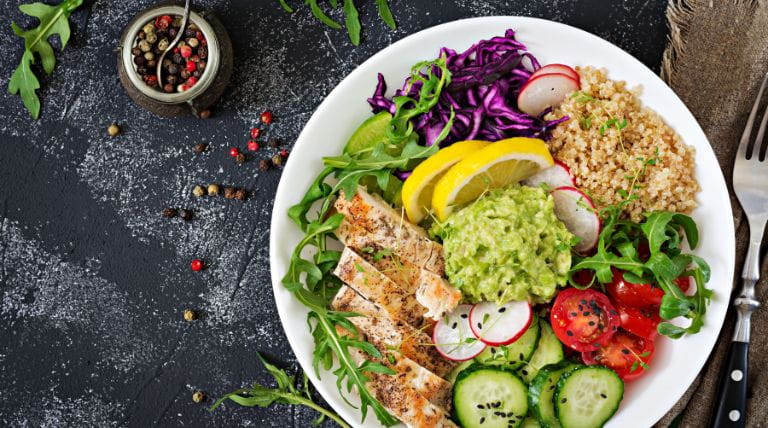
Once you understand the deficit concept, the next question is what to actually put on your plate. HPB’s My Healthy Plate is the simplest answer: fill half your plate with fruits and vegetables, a quarter with wholegrains, and a quarter with lean protein. It works without any calorie counting because the proportions do much of the work for you.
Vegetables add volume and fibre with very few calories, wholegrains release energy slowly, and lean protein helps keep you satisfied long after the meal.
The framework is easier to apply when you know what one serving actually looks like. The table below translates each food group into practical serving sizes.
| Food group | One standard serving |
| Wholegrains | ½ bowl brown rice / 2 slices wholemeal bread / 1 wholemeal chapati |
| Fruits | 1 small apple or pear / 1 wedge papaya or pineapple |
| Vegetables | ¾ mug (or a small rice bowl) of cooked vegetables |
| Meat and alternatives | Palm-sized fish or chicken / 2 eggs / 2 blocks soft beancurd |
For meal ideas built on this structure, see our recipes for healthy eating and healthy cooking tips.
Can weight loss be faster under supervision?
Yes. Professionally supervised programs can safely use larger calorie deficits than self-directed dieting, which may produce faster initial results. Dropping food intake to much lower calorie levels is exactly why these programs require professional monitoring rather than a do-it-yourself approach.
Appetite, nutrient adequacy, and weekly progress all need to be managed by someone trained to do it. It also helps to remember that rapid early losses tend to include a large amount of water weight before fat loss settles into a steadier rate.
For Singaporeans looking for a safe, supportive way to get faster results with expert guidance, a supervised program might be the perfect fit.
A daily deficit of around 500 kcal can produce about 0.5 kg of weight loss per week (HPB-MOH Clinical Practice Guidelines on Obesity, Grade A recommendation). HPB’s My Healthy Plate is a baseline tool for weight loss. However, some structured programs choose to use a different framework to achieve their results.
The Eureka Wellness program is one example. During our maintenance phase, the protocol shifts the plate’s focus entirely to non-starchy vegetables, lean protein, and a modest amount of healthy fats, omitting grains and starchy foods.
This isn’t to say the standard approach doesn’t work; it is simply a different tool built for a different strategy. A specialised, monitored framework like ours is designed for a specific metabolic phase, while HPB’s My Healthy Plate relies on balanced portions.
To learn more about how Eureka Wellness’s program is structured, please visit our program page.
Why Eating Out Makes Weight Loss Feel Challenging in Singapore ?

Eating out is one of the hardest parts because hawker meals range from about 372 to over 1,257 calories. A single rich dish can use up more than half a sedentary office worker’s daily energy needs. The problem is rarely the rice or noodles on their own — it is the oil. Fat carries 9 calories per gram, more than double that of carbohydrates or protein. So, a dish cooked with several teaspoons of oil can add hundreds of hidden calories even to an otherwise lean meal.
Knowing these rough figures helps you make informed choices when you order. The table below compares the number of calories among common hawker dishes.
| Dish | Calories (kcal) | What drives the number |
| Mala Xiang Guo | 1,257 | Chilli oils and processed meats |
| Char Kway Teow | 745 | Around 7.5 teaspoons of oil per plate |
| Laksa | 700 | Coconut cream gravy, high in saturated fat |
| Nasi Lemak | 657 | Coconut rice with fried sides |
| Chicken Rice | 617–666 | Rice cooked in chicken fat |
| Cai Fan (1 meat, 2 veg) | ~580 | Varies widely with your selections |
| Ipoh Hor Fun | 452 | Lighter, soup-based |
| Fishball Noodle Soup | 372 | One of the lowest-calorie hawker meals |
Figures compiled from HealthHub, AsiaOne, and Daniel Food Diary. Treat them as rough guides, since portions vary by stall.
You do not need to give up hawker food to lose weight. HPB’s “4Rs” make almost any order lighter:
- Skim/reduce the oily layer and skip rich, creamy gravies where you can.
- Remove poultry skin and visible fat before eating.
- Request less oil, and ask for sauces and gravy on the side.
- Replace fried or dry noodles with clear soup versions.
Cai fan is the most adjustable meal of all because you control every spoonful that lands on your plate.
How Do You Spot Hidden Sugar, Salt, and Fat?
The fastest shortcut is checking the ingredient list. Ingredients are always listed from most to least, meaning whatever is at the very top is what the product contains the most of. If sugar, salt, or fat appears in the first three slots, the food is packed with it.
The trick is knowing what to look for, because manufacturers often disguise these ingredients under names you might not recognise as sugar, salt, or fat at a glance.
| Watch for | Often listed as |
| Sugar | Sucrose, fructose, maltose, dextrose, corn syrup, cane sugar, molasses |
| Fat | Palm oil, shortening, hydrogenated vegetable fat, cream, cocoa butter, tallow |
| Sodium | MSG, sea salt, sodium bicarbonate, stock cubes, sodium benzoate |
- The Healthier Choice Symbol flags products lower in sugar, saturated fat, or sodium.
- Nutri-Grade grades drinks from A to D; choose A or B.
- Healthier Dining Partner stalls offer at least one meal under 500 calories.
Hidden sugar deserves its own attention, since it hides in sauces, drinks, and snacks you might never suspect. For the full list, see 18 surprising foods and drinks loaded with hidden sugar, our guide to reading nutrition labels, and how ultra-processed foods keep you eating more.
How Do Fibre, Protein, and Hydration Keep You Full?
Fibre, protein, and hydration are three of the most powerful elements that drive satiety (the feeling of being full and satisfied). They make an eating plan much easier to follow because they let you cut calories without constantly feeling hungry or deprived.
Fibre comes in two forms. Soluble fibre, found in foods such as oats, barley, and legumes, slows digestion and helps steady blood sugar. Insoluble fibre, found in foods such as wholegrains, vegetables, and leafy greens, adds bulk and slows how fast you eat. Singapore General Hospital dietitians note that for most people, fibre from whole foods tends to work better than fibre supplements. It helps to build your fibre intake from whole foods first. Increase fibre gradually, alongside 6 to 8 glasses of water a day, to avoid bloating and constipation.
Protein contributes the most to fullness out of the three. A palm-sized portion at each main meal helps preserve muscle during a deficit and tends to produce the strongest sense of satisfaction per calorie of any macronutrient. Hydration rounds it out. Thirst is often misread as hunger, so what your body actually needs at 4 PM is sometimes just a glass of water.
Pairing protein and fibre with your carbohydrates can also soften the blood-sugar spike that drives later cravings. For specific details, check our guide on food combinations.
What Role Does Mindset Play in Eating For Weight Loss?
Mindset matters because extreme restriction often backfires. The brain alone needs roughly 130 grams of glucose a day to function, and when chronic stress raises cortisol, it can push you toward intense cravings for fatty, sugary foods. Singapore’s long working hours and high-pressure desk jobs can make this pattern worse, turning food into a quick source of relief during a stressful afternoon.
Three habits help break the cycle:
- Differentiate physical hunger from emotional hunger. Before eating, pause and check whether the urge is true hunger or just stress, boredom, or tiredness.
- Eat without screens. Eating slowly and without distraction gives your body time to register fullness before you overeat.
- Track your patterns. A food diary or the Healthy 365 app makes your real triggers visible.
Poor diet quality and constant stress do not only affect weight. Over time, they can raise bad cholesterol and chronic inflammation, both of which make weight loss harder. For more information, see this practical guide to mindful eating for busy professionals in Singapore, find out if inflammation is sabotaging your efforts, or learn how to lower bad cholesterol.
How Do Meal Prep and Grocery Choices Make Weight Loss Sustainable?
Meal prep is one of the most reliable ways to turn good intentions into steady results, because it removes daily decision fatigue and hands you control over ingredients, portions, and cooking methods. A simple template is one lean protein, one whole grain, and two vegetable portions per meal.
You do not need imported ingredients to eat well. Local fish like ikan kembong and ikan batang offer nutrition comparable to salmon at a fraction of the cost, and local greens such as kailan and kangkong stand in easily for imported broccoli. For Singaporeans who are short on time, commercial meal-prep services offer calorie-controlled options.
Frequently Asked Questions
How many calories should I eat to lose weight in Singapore?
Average daily maintenance is roughly 2,200 kcal for adult men and 1,800 kcal for adult women, based on HPB benchmarks. Eating about 500 kcal below your own maintenance level leads to roughly 0.5 kg of weight loss per week. For a number tailored to you, use the Healthy 365 app or consult a registered dietitian.
Can I lose weight while still eating hawker food?
Yes. Choose soup-based dishes over fried ones, ask for less rice or noodles, and look out for Healthier Dining Partner stalls. Dishes like sliced fish soup stay under 500 calories and offer pure, whole-food protein. If you choose Ipoh hor fun, you get excellent whole foods like shredded chicken and prawn. Just ask for less of the thick, starchy gravy to avoid hidden sugars. Clear-soup yong tau foo is also a fantastic option, provided you stick to whole items like fresh tofu, mushrooms, and leafy greens instead of processed fishballs or fried options. Whichever soup or saucy dish you pick, just remember to leave the liquid behind to avoid consuming excess hidden sodium.
Is intermittent fasting better than calorie counting for Singaporeans?
Neither is automatically better, because both work by creating a calorie deficit. The right choice is the one that you can keep up with around your work schedule and social events. Sustainability matters more than intensity.
How much protein do I need to lose weight without losing muscle?
General guidance is 1.2 to 1.6 grams of protein per kilogram of body weight a day during a deficit, spread across your meals. Your exact target depends on your activity level and starting point, which our protein guide covers in detail.
How long does it take to see results?
With a self-directed approach, expect 1 to 3 kg of weight loss in the first month depending on the starting weight, followed by a steady pace of 0.3 to 0.5 kg per week. Early weeks often show faster drops from water weight before fat loss steadies. Professionally supervised programs can safely produce faster initial results than self-directed dieting, as they use larger, clinically monitored deficits.
Bringing It Together
Sustainable weight loss in Singapore thrives on consistency. Willpower alone is hard to sustain against the country’s rich food culture, so a workable plan matters more than an unrealistic standard of perfection. The calorie deficit delivers the results, but food literacy, mindset, and daily habits are what keep them. The cluster guides linked throughout this page go deeper into each piece.
If you prefer to do it on your own, the framework here aligns with HPB-MOH guidelines for a healthy weight loss pace of 0.5 to 1 kg per week. For a self-directed approach, aiming for the steady pace of up to 0.5 kg per week via a manageable 500 kcal deficit daily is the safest way to protect your muscle mass and keep the weight off.
If you would rather have faster results with professional guidance, Eureka Wellness’s healthy weight loss programme offers a supervised approach with structured nutrition planning and regular monitoring. Individual results vary.
Sources
- Health Promotion Board and Ministry of Health — Clinical Practice Guidelines: Obesity (Singapore Medical Journal)
- HealthHub (HPB) — Plan Your Meals with My Healthy Plate; Healthy Meals with My Healthy Plate (eating out)
- Health Promotion Board — Healthier Choice Symbol; Nutri-Grade beverage scheme; Healthier Dining Programme
- HealthHub (HPB) — Nutritious Foods for a Healthy Diet
- HealthXchange — Eating Right: Healthy Plate and Understanding Food Labels
- Singapore General Hospital — Dietary Fibre (commentary by Principal Dietitian Ms. Chong Ai Heong)
Figures in this guide are based on HPB and MOH guidelines available as of July 2026. Check official sources for the most current recommendations.