

Singapore supermarket labels carry four layers of regulated information: the back-of-pack Nutrition Information Panel, the front-of-pack Nutri-Grade badge, the Healthier Choice Symbol, and marketing claims like “low fat.” A set of new labelling rules also came into operation on 30 January 2026. This guide walks through each layer in the order that shoppers should actually read them.
Key Takeaways
|
Why Are Singapore’s Nutrition Labels So Layered?
Three government entities oversee food labelling in Singapore. The Singapore Food Agency (SFA) handles food safety, ingredient declarations, and country-of-origin rules, while the Ministry of Health (MOH) and the Health Promotion Board (HPB) handle nutrition labelling, the Healthier Choice Symbol, and the Nutri-Grade system.
These rules are tightening specifically because Singaporeans are consuming too much sugar and salt. According to the HPB, prepackaged beverages account for around 64% of daily sugar intake for more than half of Singapore residents. Meanwhile, the National Population Health Survey 2024 reveals that hypertension (high blood pressure) now affects 33.8% of adult residents.
This troubling health data is exactly why the government introduced the mandatory Nutri-Grade badge to cut down sugar, starting with beverages. It is also why they are currently pushing to reduce sodium (salt) in local food, with plans to widen these strict labelling rules into new product categories like sauces and instant noodles in 2027.
What Does the Nutrition Information Panel Actually Tell You?
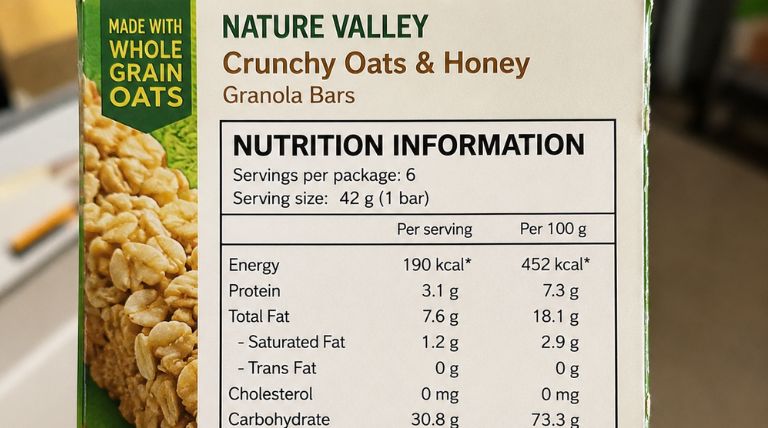
The Nutrition Information Panel, or NIP, is the small grid on the back or side of the pack listing energy, protein, fat, carbohydrates, sugar, and sodium. The SFA requires the NIP on any product carrying a nutrition or health claim, on every Nutri-Grade beverage, and on edible oils and special-purpose foods like infant formula. The NIP shows two columns: “per serving” and “per 100 g” or “per 100 ml.” The “per serving” column is the one that misleads shoppers most often, because the manufacturer (not a government regulator) sets the serving size.
A bag of potato chips listing 160 calories per 30 g serving may hold ten servings, which means finishing the pack delivers 1,600 calories. The “per 100 g” or “per 100 ml” column solves this. Because the 100 g or 100 ml column is a regulated, standardised baseline, you can instantly compare different packaged items in the same aisle.
Whether you are looking at two brands of yoghurt drinks, potato chips, or canned soups, this column creates a level playing field. It allows you to see which product actually has less sugar, fat, or sodium — regardless of how unrealistic each manufacturer’s individual “serving size” is.
How Does Nutri-Grade Work?
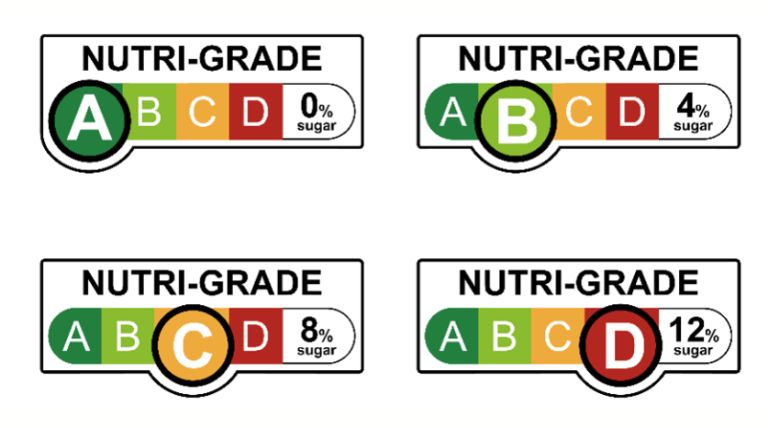
Nutri-Grade is the colour-coded badge that HPB introduced for prepackaged beverages. The system was later extended to freshly prepared drinks at kopitiams, bubble tea shops, and digital ordering apps.
The system rates items from A (lowest sugar/fat) to D (highest sugar/fat) based on their nutrients per 100 ml or 100 g.
| Grade | Colour | Sugar (per 100 ml) | Saturated Fat (per 100 ml) | Display Rule |
| A | Dark Green | ≤ 1.0 g | ≤ 0.7 g | Optional |
| B | Light Green | > 1.0 to 5.0 g | > 0.7 to 1.2 g | Optional |
| C | Yellow | > 5.0 to 10.0 g | > 1.2 to 2.8 g | Mandatory on pack and menu |
| D | Red | > 10.0 g | > 2.8 g | Mandatory; advertising banned |
To see how a grade is decided, it helps to look at two main rules:
Rule 1: The worst grade wins. Nutri-Grade looks at both sugar and saturated fat. Whichever nutrient gets the unhealthier score determines the final grade. For example, a “Zero Sugar” 3-in-1 coffee packet sounds healthy, but because it uses a fatty palm-oil creamer that packs 3 g of saturated fat per 100 ml, it gets dragged straight down to a Grade D. The lack of sugar cannot save it from its high fat content.
Rule 2: Products with artificial sweeteners cannot get an A. Grade A is strictly reserved for drinks with no sugar and zero sweeteners. If a diet soda uses artificial sweeteners (like stevia or aspartame), it is automatically capped at a Grade B, even if it has zero sugar. This prevents brands from using chemicals to make a drink pass as perfectly healthy.
Why Nutri-Grade Doesn’t Tell the Full Story
Because the system only calculates sugar and saturated fat, it cannot measure overall nutritional value. This creates a massive blind spot for shoppers. For example, a pure, unsweetened coconut milk or a nutrient-dense whole milk might get a Grade C or D simply due to natural fats. Meanwhile, a diet soda loaded with artificial chemical additives easily scores a Grade B because it contains zero sugar.
Use Nutri-Grade as a quick warning system for sugar and fat, but don’t assume a “B” means a drink is automatically good for you!
What Does the Healthier Choice Symbol Actually Mean?
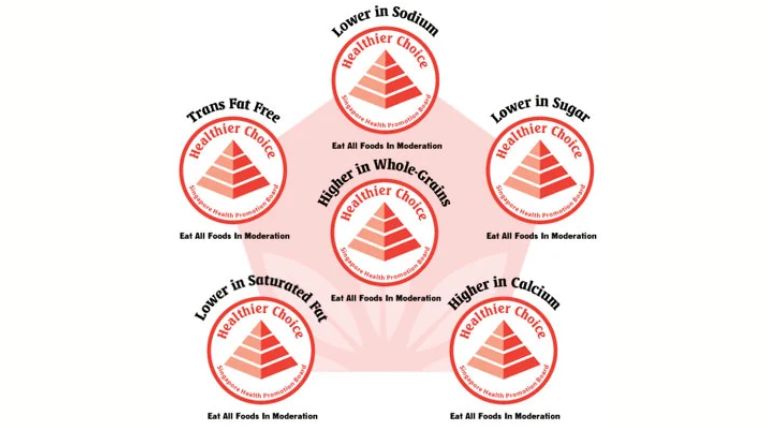
The Healthier Choice Symbol, or HCS, is the familiar red-and-green logo that HPB places on thousands of products across over 100 food categories. The HCS is voluntary, and the symbol compares products within the same food group. This means an HCS-certified whole-grain bread is a healthier option compared to other breads on the shelf — but it isn’t automatically healthier than a bowl of fresh vegetables.
Every symbol carries a specific tagline explaining its exact advantage (such as “Lower in Sugar” or “Higher in Wholegrains”), along with the reminder to “Eat all foods in moderation.”
The HCS and Nutri-Grade systems work together: no beverage graded C or D can carry the HCS, which means the symbol only appears on drinks already graded A or B.
What Do “Low Fat” and “No Added Sugar” Legally Mean?
Singapore strictly regulates what food companies can print on their packaging. Nutritional claims are broken into two legal categories:
- Absolute Claims: Words like “sugar-free” or “low fat” cannot be guessed. A product must test below a strict legal threshold per 100 g or 100 ml to use these words.
- Comparative Claims: Phrases like “25% less sodium” require the product to have at least a 25% reduction compared to a regular version, and the manufacturer must legally name that comparison product on the label.
| Claim | Solid Food (per 100 g) | Liquid Food (per 100 ml) |
| Sugar-Free | ≤ 0.5 g | ≤ 0.5 g |
| Low Sugar | ≤ 5 g | ≤ 2.5 g |
| Low Fat | ≤ 3 g | ≤ 1.5 g |
| Low Saturated Fat | ≤ 1.5 g | ≤ 0.75 g |
| Low Sodium | ≤ 120 mg | ≤ 120 mg |
| High Fibre | ≥ 6 g | ≥ 3 g |
One further rule applies across every claim: no food label in Singapore can claim to prevent, treat, or cure a disease. The 2026 amendments also added new rules around ingredient lists, country of origin, and gluten-free claims.
What Changed Under the Latest Labelling Reforms?
The Food (Amendment) Regulations 2025, which came into operation on 30 January 2026, are the most significant labelling update Singapore has introduced in recent years. The five changes most relevant to shoppers are:
- Ingredients lists must carry an “Ingredients” heading, with items in descending order by weight.
- Added water must be declared as an ingredient, unless the water forms part of a compound ingredient like brine, evaporates during processing, or makes up less than 5% of the finished product.
- Flavourings must be qualified — labels can no longer simply say “flavour” and must state “Natural,” “Artificial,” or “Nature-identical.”
- Country of origin is now mandatory on all prepackaged foods, including those made in Singapore. Simple repacking does not qualify a product as “Made in Singapore” even if it is done in an SFA-licensed facility. To use that label, the manufacturing process must actually transform the food into something new (like turning raw imported almonds into almond milk) in an SFA-licensed facility.
- Gluten-free is now a quantitative claim. A product can only be labelled gluten-free if it contains 20 mg of gluten per kilogram or less.
Which Label Tricks Should Shoppers Watch For?
Most front-of-pack claims are technically accurate but can still mislead shoppers. Watch out for these four repeated labelling traps when browsing supermarket aisles.
#1 — The “Low Fat” trap. When manufacturers remove fat from a recipe, it’s usually replaced with sugar, starch, or refined flour to preserve texture and flavour. The low-fat version of a salad dressing or yoghurt may carry the same calories (sometimes more) than the full-fat original version. Compare calories and sugar per 100 g between the two versions, not just the front-of-pack claim.
#2 — The “No Added Sugar” trap. “No added sugar” means the manufacturer did not add refined sugar, but the product can still hold high levels of natural sugars from fruit, milk, or honey.
Because natural sugar still spikes blood sugar and counts toward the strict limits measured by Nutri-Grade, even 100% pure, unsweetened fruit juices are capped and can never achieve a Grade A — they are restricted to a B or C grade. Always check the total sugar content on the back panel, not just the “no added sugar” claim on the front.
#3 — The “Sugar Splitting” trap. Ingredients must legally be listed from heaviest to lightest. If a manufacturer uses a massive amount of regular sugar, “Sugar” has to be the very first word on the label, which scares away health-conscious shoppers.
To hide this, companies split sugar into different names like cane sugar, glucose syrup, fructose, maltodextrin, or honey. Because the total amount is broken into smaller pieces, each individual name looks small and gets pushed way down to the bottom of the list. Don’t be fooled: if you see three or four different types of sugar scattered across the ingredient list, the product is likely packed with sugar.
#4 — The Nutri-Grade gap. A drink can hold a Nutri-Grade B badge and still contain artificial colourings, flavour enhancers, and acidity regulators. Nutri-Grade measures sugar and saturated fat — the system does not assess additives, preservatives, or ingredient quality. The front-of-pack grade is just a quick snapshot, not the full story of what’s inside the drink.
Frequently Asked Questions
What is the difference between Nutri-Grade and the Healthier Choice Symbol?
Nutri-Grade is a mandatory grade from A to D applied to beverages, based on sugar and saturated fat per 100 ml. The Healthier Choice Symbol is voluntary and category-based, marking products that meet HPB’s healthier criteria within their food group. The two systems work together: a beverage graded C or D cannot carry the Healthier Choice Symbol.
Is “no added sugar” the same as sugar-free?
No. “No added sugar” means the manufacturer did not add any sugar during production, but the product can still contain high amounts of natural sugar from ingredients like fruit, milk, or honey. “Sugar-free” is a strict legal claim — the final product must contain 0.5 g of total sugar or less per 100 g or 100 ml.
Why are some 100% fruit juices rated Grade C under Nutri-Grade?
Nutri-Grade measures total sugar per 100 ml without distinguishing between added and naturally occurring sugars. Pure fruit juices can exceed the 10 g per 100 ml threshold from natural sugar alone, which places several common fruit juices in Grade C.
Which key markers should everyday shoppers focus on?
Most shoppers can focus on four key markers in the Nutrition Information Panel: energy (calories), total sugar, sodium, and saturated fat. These four are most closely linked to long-term health goals, and they form the exact foundation that Singapore’s Healthier Choice and Nutri-Grade systems are built around.
When will the new Nutri-Grade rules for sauces and instant noodles take effect?
From mid-2027, Nutri-Grade labels and advertising restrictions will also apply to prepacked salt, sauces, seasonings, instant noodles, and cooking oils. Twenty-three sub-categories will be graded using thresholds tailored to each food type, and Grade D products will face advertising restrictions similar to Grade D beverages.
Can a product labelled “Made in Singapore” actually be imported and repacked?
Not since 30 January 2026. Under the Food (Amendment) Regulations 2025, a product can only be labelled “Made in Singapore” if it undergoes a substantial manufacturing process that changes the food’s nature within an SFA-licensed facility. Bulk imports that are simply repacked locally must instead state “Product of [Origin Country], Packed in Singapore.”
Becoming a Label-Smart Shopper
Navigating the supermarket aisles shouldn’t feel like decoding a legal text. As Singapore’s food labelling regulations evolve, the power shifts back into your hands — if you know exactly where to look.
The biggest takeaway for your next grocery run is to look past the front-of-pack marketing claims and head straight for the facts on the back.
Healthy eating starts with having a clear vision, but you don’t have to navigate it alone. At Eureka Wellness, we help clients turn label reading into practical food choices through personalised nutrition guidance, meal planning, and sustainable lifestyle habits.
If you would like a structured starting point, we can help build a plan that fits how you actually shop and eat, empowering you to confidently outsmart marketing traps and take full control of your metabolic health.
Last updated: June 2026. This article reflects Singapore’s nutrition labelling rules current as of June 2026, including the Food (Amendment) Regulations 2025 that came into operation on 30 January 2026. Rates, thresholds, and regulations may change; verify current rules directly with the Singapore Food Agency and Health Promotion Board.