Calories are simply a measure of energy contained in the food and drinks we consume. They are usually labelled as “kcal” on the packaging. The fundamental principle of weight loss remains unchanged, even with the trends that come and go. “When we consistently consume more calories than our body needs, the excess is stored as fat.”
Just how many calories should you consume to lose weight? Today, you will get to understand your calorie requirements and learn some strategies to manage your intake.
Your Daily Calorie Needs
Your calorie needs are as unique as you are. There are general guidelines that can provide a starting point for you but here are the factors that influence how many calories your body requires each day.
Age
As we age, our metabolism naturally slows down, meaning our calorie needs decrease over time. Someone in their 20s generally requires more calories than someone in their 60s, even if they are the same weight and activity level.
Sex
In general, men have more muscle mass and less body fat than women of comparable size. Hence, the higher calorie needs. Males need approximately 2,200 calories daily while 1,800 calories is the daily calorie intake for women.
Height and Weight
Larger bodies require more energy to function. A taller person or someone with a higher weight will need more calories than someone smaller. This is why personalised calculations are more effective than one-size-fits-all approaches.
Activity Level
Perhaps the most significant variable in your calorie equation is how active you are. If you are someone who exercises regularly or has a physically demanding job, you will burn substantially more calories than someone who is sedentary.
We can categorise activity levels as follows:
- Sedentary: Little to no exercise
- Lightly active: Light exercise one to three days weekly
- Moderately active: Moderate exercise three to five days per week
- Very active: intense exercise six to seven days per week
- Extra active: Very intense exercise and/or a physically demanding job (e.g., endurance athletes and individuals with physically demanding occupations such as heavy construction)
Basic Calorie Requirements by Demographic
These guidelines below provide a useful reference point for everyone.
Adult Men:
- Ages 19-30: 2,400 to 3,000 calories daily
- Ages 31-60: 2,200 to 3,000 calories daily
- Ages 61+: 2,000 to 2,600 calories daily
Adult Women:
- Ages 19-30: 2,000 to 2,400 calories daily
- Ages 31-60: 1,600 to 2,200 calories daily
- Ages 61+: 1,600 to 2,000 calories daily
Calculating Your Personal Calorie Target
Here is how to calculate a personalised calorie target.
The 15-Calories-Per-Pound Rule
“How many calories are needed for weight loss?” This may be a question that has been asked innumerable times by many people. Before this gets answered, let’s discuss the computation for maintenance calories first so you’ll know how many calories you should consume less or burn.
A simple starting point for estimating your maintenance calories or the amount needed to maintain your current weight is the 15-calories-per-pound rule. This works best if you are moderately active, meaning you get at least 30 minutes of physical activity daily.
Example of calculation:
If you weigh 155 pounds (or 70.3 kg), that is 155 x 15 = 2,325 calories. This means you need approximately 2,325 calories to maintain your current weight.
If you’re sedentary or doing only minimal physical activity daily, you might multiply by 13 instead of 15. If you are very active, you might use 17 or 18 as your multiplier.
Creating a Safe Calorie Deficit
If you want your weight loss to be sustainable, aim to lose 1 to 2 pounds per week (0.45 kg to 0.91 kg). This requires a calorie deficit of 500-1,000 calories per day:
- 500 calorie daily deficit = approx. 1 pound loss per week
- 1,000 calorie daily deficit = approx. 2 pounds loss per week
Using our example,
- Maintenance calories: 2,325 per day
- For 1 lb weekly loss: 2,325 – 500 = 1,825 calories per day
- For 2 lbs weekly loss: 2,325-1,000 = 1,325 calories per day
Important Safety Thresholds
No matter what your weight loss goals are, there are minimum thresholds you should not go below without consulting your doctor.
- For women, the minimum is 1,200 calories per day
- For men, it’s 1,500 calories per day
Role of Physical Activity
It’s not necessary that you create your calorie deficit through diet alone. For example, instead of reducing your daily intake by 500 calories, you may reduce your food intake by 300 calories and burn an additional 200 calories through exercise.
Structuring Your Daily Calorie Intake
Once you have determined your daily calorie target, the next thing to know is how to distribute those calories throughout the day.
Recommended Meal Distribution
There’s no single “perfect” way to structure your meals but you can divide your calories to help prevent extreme hunger that might cause you to overeat. Here is a common approach.
For women (based on 1,400 calories per day)
- Breakfast: 280 calories (20% of daily total)
- Lunch: 420 calories (30% of daily total)
- Dinner: 420 calories (30% of daily total)
- Snacks and drinks: 280 calories (20% of daily total)
For men (based on 1,900 calories per day)
- Breakfast: 380 calories (20% of daily total)
- Lunch: 570 calories (30% of daily total)
- Dinner: 570 calories (30% of daily total)
- Snacks and drinks: 380 calories (20% of daily total)
Meal Timing & Frequency
The usual three-meal approach works well for many people. There are also those whose preferences and schedules differ. Some alternative structures that you can try are:
Intermittent fasting
- 16:8 method (eating within an 8-hour window)
- 5:2 method (eating normally 5 days, restricted calories 2 days)
More frequent but smaller meals
- 5-6 smaller meals spread throughout the day
- This may be helpful to those who prefer to eat more frequently in smaller portions
Managing Your Calorie Intake
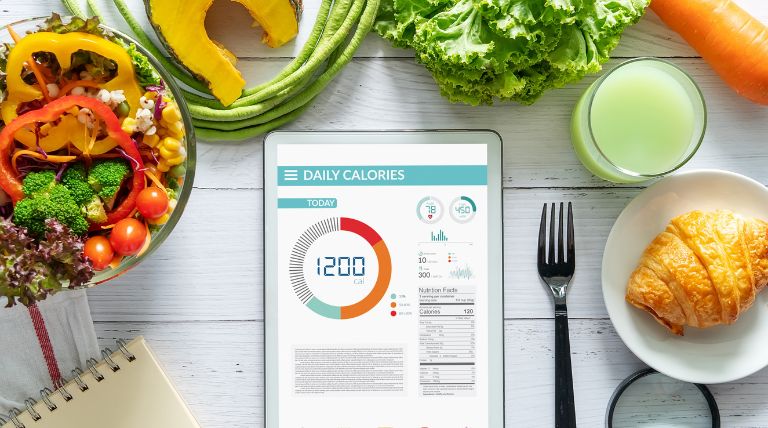
This doesn’t have to feel like a full-time job. You can make calorie awareness a natural part of your daily routine through these approaches below, so you can stay on track with your goals.
Reading Nutrition Labels Effectively
Nutrition labels contain valuable information and they are more useful if you know what to focus on.
First, the serving size. Check this first, as all nutrition information is based on this amount. Many packages contain multiple servings and the calories per serving. Multiply this by the number of servings you are consuming.
After this, use labels to choose lower-calorie alternatives of similar foods. Lastly, screen through is the ingredient list. Foods with added sugars, processed oils, and refined grains often have more calories with less nutritional value.
Remember that “fat-free” does not mean “calorie-free.” Many fat-free products contain added sugars to improve taste, so they may have similar or even higher calorie counts than the regular versions.
Portion Control Strategies Worth Trying
- Use smaller plates.
- Measure once, remember the visual.
- Use your hand as a guide.
- Protein (palm-sized portion)
- Veggies (fist-sized portion)
- Carbohydrates (cupped hand portion)
- Fats (thumb-sized portion)
- Pre-portion snack foods.
- When eating outside,
- Split entrees (main dish)
- Order an appetiser as your main, or
- Pack half your meal to go
Common Calorie Counting Mistakes
No matter how we try to be careful, there could still be some errors that can affect your calorie counts.
- Forgetting cooking oils and spreads. A tablespoon of olive oil easily adds 120 calories.
- Ignoring the calories of beverages. Drinks can contain hundreds of calories.
- Inaccurate estimation of portions. Studies show that most people underestimate portions by 20% to 50%.
- Weekend amnesia. It’s wrong to track only on weekdays. Include Weekends should be included.
- Not counting the tasting portions while cooking. Include those times that you’re having a bite of the food you’re cooking.
- Assuming all salads are low in calories. Dressings, cheese, nuts, and dried fruits will make your salads calorie-dense.
Beyond Calorie Counting
Do not focus solely on the numbers because it’s easy to miss important aspects of nutrition if we are too drawn to or immersed in calorie counting. Quality matters just as much as quantity.
Not all calories are equal. Two hundred calories of veggies give more vitamins, minerals, and fibre than 200 calories of processed snacks. Focus on whole foods like fruits, veggies, lean proteins, whole grains and healthy fats.
Some Recommendations
Include at least five portions of fruits and vegetables daily (a portion is about 80g). If you eat fish, aim for at least two portions weekly including one portion of oily fish (about 140g per portion).
Making It Sustainable
The real challenge does not end with losing weight but maintaining that loss over time. The secret is to create sustainable habits.
- Establish regular eating schedules. Consistency in when you eat is as important as what you eat. Your eating schedule must accommodate your lifestyle and hunger patterns.
- Once you have reached your weight loss goal, slowly increase calories (by 100 to 200 per week) until you find your maintenance level.
- Continue weighing weekly or bi-weekly to catch small regains before they become significant.
- A smart tip is to prepare for challenges like holidays and travel. You must have plans for navigating these situations.
- If you notice improvements in your energy, mood, fitness and health markers, this is already a victory. Don’t just celebrate for the number on the scale.
Conclusion
Managing calorie intake establishes a powerful framework for weight loss, but sustainable results come from a holistic approach that considers not just how much you eat, but also what you eat and how you live.
The most successful approach is one you can maintain, even after you reach your goal weight—and adapt as a lifestyle that supports your well-being.