


Key Takeaways
|
Why Traditional Dieting Can Be Difficult to Sustain in High-Stress Work Environments
Traditional dieting approaches often struggle in high-stress, fast-paced work cultures like Singapore. They tend to rely on planning, regular meal timing, and some level of restriction — factors that are harder to sustain with long hours, stress-driven eating, and constant access to convenient, energy-dense foods. As a result, people are more likely to choose what is quick, comforting, or social, rather than what best supports their health.
Mindful eating offers a more flexible alternative, which we’ll explore in the next section.
What is Mindful Eating?

Mindful eating is the application of practising mindfulness to food, which involves being fully present and non-judgmental while eating. It focuses on using all senses to appreciate food, recognising physical hunger and satiety cues, and acknowledging emotional responses to eating, all of which can support a healthier relationship with food.
It is not a diet or a meal plan. It is a skill rooted in mindfulness practices that may improve with consistency over time. Research suggests mindfulness-based approaches may help some people reduce episodes of binge eating and emotional eating by building non-judgmental awareness of cravings and emotional triggers, though results vary from person to person.
How Mindful Eating May Support Weight Loss
Much of overeating is not driven by physical hunger. Stress, habitual eating patterns, and easy access to food all play a role. Distractions such as eating while working or scrolling may also reduce the brain’s ability to register satiety signals, which can lead to consuming more than we otherwise would.
When you pay attention to fullness cues, you may find yourself stopping sooner. Small shifts in portion and pace can add up over weeks and months. Mindful eating is not a quick fix, but a gradual shift in eating habits over time.
There may also be a knock-on benefit for energy. Rushed, distracted meals can lead to less stable post-meal energy — what some people experience as the afternoon slump. Slowing down and making more intentional food choices may help, though responses though the effects may not be the same for everyone, so it helps to observe your own experience.
How to Practice Mindful Eating When You’re Short on Time
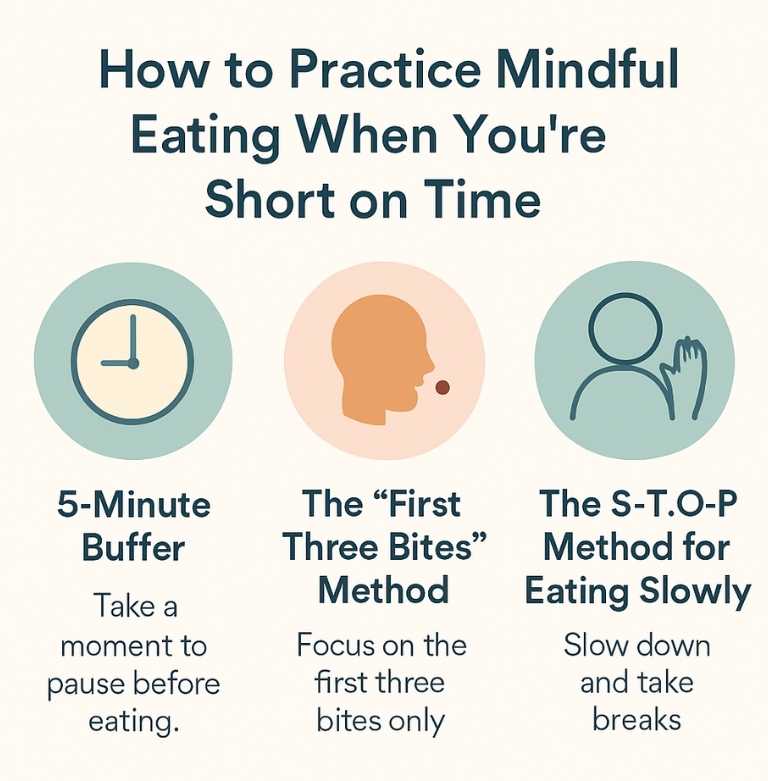
Mindful eating doesn’t require long, silent meals. Small, consistent shifts often matter more than occasional long ones. The techniques below are designed to fit into a workday.
5-Minute Buffer
Give yourself a short buffer before eating. Take five minutes to quickly check messages or wrap up anything urgent, then step away from your screen and put your phone aside. This helps break the habit of eating while working or scrolling, which can reduce awareness of hunger and fullness.
The “First Three Bites” Method
Give full attention to the first three bites of your meal. Notice the flavour, texture, and aroma. This can satisfy what some researchers describe as sensory hunger (the brain’s desire for novelty and pleasure from food), which may leave you feeling more content with a smaller portion.
The S-T-O-P Method for Eating Slowly
- Select your portion intentionally before you begin eating.
- Taste with focus, put your phone down.
- Observe your fullness around the halfway point.
- Pause before deciding on seconds or dessert.
Mindful Eating in Singapore’s Food Environment
Applying mindful eating in Singapore’s dense, convenient food landscape requires practical strategies. The three scenarios below reflect where most of daily eating happens for working professionals.
At the Hawker Centre
Hawker food is not the problem it is often made out to be. Hawker centres across Singapore offer plenty of balanced options. The challenge tends to be how we choose, not what is available.
One common example is economy rice (cai fan), where choices are made dish by dish. When ordering, try the Health Promotion Board’s “Quarter, Quarter, Half” guide: roughly a quarter of the plate for protein, a quarter for carbohydrates, and half for vegetables. Use the moment of ordering as a pause to ask whether the choice reflects real hunger or habit.
Ordering on Food Delivery Apps
GrabFood and Foodpanda make impulsive ordering almost effortless, especially when hunger kicks in. A simple fix is to decide what to order ahead of time. Having a few balanced go-to meals saved can help you avoid decision fatigue, when emotional eating tends to creep in.
At the Office
Office pantries are where eating habits can quietly form. A “mindful snack kit” prepared in advance (unsalted nuts, Greek yoghurt, or fresh fruits) can offer an alternative to the default biscuit tin. Before reaching for a packaged drink, the Nutri-Grade label (A to D) can serve as a brief pause point.
One more note: in our humid climate, thirst is sometimes mistaken for hunger. Sipping water regularly throughout the day can help you tell the two apart.
Why Knowing May Not Be Enough
Most people reading this likely already have a general understanding of what supports weight loss. The gap between understanding and consistent application (in real-life moments, during a stressful week, or with a dinner meeting on the calendar) is where many efforts stall.
This is where coaching can help. A healthy weight loss programme goes beyond meal plans and calorie tracking; it addresses the behavioural and emotional factors of eating. Personalised coaching offers accountability, strategies tailored to your schedule, and support during the low-motivation stretches.
Alongside this behavioural support, wearable devices such as the Apple Watch or Oura Ring can provide useful signals on sleep, heart rate variability, and stress. However, data alone does not change behaviour. Coaching helps translate these signals into practical adjustments that fit your life, and into an approach to weight loss that also supports mental health.
Making Mindful Eating Work For You

Mindful eating is a skill. With practice, it may help you build a steadier, more intentional relationship with food — one that fits the demands of working life in Singapore rather than disrupting your routines.
If you’re exploring a more supported approach to healthy eating and weight management, Eureka Wellness offers a holistic programme designed for busy professionals. The focus goes beyond diet plans, incorporating behavioural strategies and practical guidance that fit into real-world schedules. The aim is not quick fixes, but sustainable changes that can be maintained alongside work, social commitments, and daily routines.
Frequently Asked Questions
Can mindful eating help with eating disorders?
Mindful eating is sometimes used as a complementary approach (such as alongside cognitive therapy) in the professional treatment of eating disorders. It is not a standalone treatment. Anyone who suspects they may be experiencing disordered eating is encouraged to consult a qualified healthcare professional for appropriate support.
Does mindful eating require a specific diet?
No. Mindful eating is not tied to any particular meal plan, diet or food philosophy. It can be practised with any type of food or eating pattern. The focus is on awareness — learning to listen to your internal hunger and fullness cues.
How long does it take to see results?
Results vary considerably between individuals. Some people may notice shifts in their habits and energy within a few weeks, while more noticeable weight changes may take several months of consistent practice.
Is mindful eating backed by science?
Research on mindfulness-based eating approaches is growing but still evolving. Several studies suggest potential benefits for improving binge eating, emotional eating, and weight-related outcomes, though findings are not uniform and more research is ongoing.