

When most people embark on a fitness journey, they often face a frustrating choice—lose weight or build muscle. The conventional wisdom has long suggested that these goals are contradictory—that you must choose one or cycle between them.
But what if you could achieve both at the same time?
This process is known as body recomposition. Let’s explore how to navigate this challenging but rewarding process.
Understanding Body Composition

When a person thinks about improving his or her physique, instinctively, he or she would think about weight loss. However, the number on your scale tells only a small part of the story—and can be sometimes misleading.
Body composition, which refers to the proportion of fat and fat-free mass (muscle, bone, water) in your body, provides a much more meaningful picture of your physical health and appearance.
Why Body Composition Matters
Your body weight alone cannot distinguish a pound of muscle and a pound of fat. Two individuals with the same height and weight can look significantly different depending on their body composition.
The person with more muscle and less fat will appear more toned, fit, and generally healthier.
More importantly, body composition directly influences your:
- Metabolic rate
Muscle tissue is metabolically active, burning more calories at rest than fat tissue. Higher muscle mass means a higher resting metabolic rate. - Functional strength
Greater muscle mass translates to improved physical performance in daily activities, from carrying groceries to climbing stairs. - Long-term health outcome
Research shows that lower body fat percentage (especially visceral fat around organs) and higher muscle mass correlate with reduced risk of chronic diseases, including diabetes, heart disease, and certain cancers. - Hormonal balance
Body composition affects, and is affected by, key hormones including insulin, cortisol, growth hormone, and sex hormones. So there’s a cyclical relationship between your body’s makeup and its biochemical functioning.
Measuring Body Composition
Unlike simple weight measurement, body composition can be assessed through various methods:
- Body circumference measurements (waist, hips, arms, thighs)
- Skinfold thickness tests
- Bioelectrical impedance analysis (BIA)
- Dual-energy X-ray absorptiometry (DEXA)
- Hydrostatic weighing
Some methods are more accurate than others, but even basic measurements like waist circumference can offer insights of the changes in your body composition over time.
Some Misconceptions to Learn About
Many people hold beliefs about body composition that can hinder their progress.
- Weight loss always means fat loss. Without proper nutrition and exercise, weight loss usually includes significant muscle loss.
- Women will “bulk up” from strength training. Women typically lack the testosterone levels needed for substantial muscle growth. Strength training helps women develop tone, strength, and improved body composition.
- Spot reduction is possible. You cannot selectively lose fat from specific body parts through targeted exercises. Fat loss occurs throughout the body based on genetic factors and overall fat reduction.
- Muscles turn to fat when you stop exercising. Muscle and fat are different tissues that cannot transform into each other. When activity decreases, muscles may atrophy (decrease in size) while fat may increase.
The Science Behind Body Recomposition
Body recomposition challenges traditional wisdom about fitness and weight management. To understand why this process is possible and how to achieve it effectively, we must examine the underlying physiological mechanisms at work.
The Physiological Paradox
Traditional approaches to body transformation recommend either of the following:
- A caloric surplus to build muscle (bulking)
- A caloric deficit to lose fat (cutting)
This advice stems from a fundamental physiological reality: muscle protein synthesis requires an energy surplus, while fat loss requires an energy deficit. This contradiction explains why many professionals recommend alternating bulking and cutting phases.
However, research and practical experience have demonstrated that under specific conditions, the body can indeed build muscle and lose fat simultaneously.
Hormonal Foundations of Body Recomposition
Several hormones govern the processes of muscle growth and fat metabolism.
- Insulin – Often called the storage hormone, insulin drives nutrients into the cells. Higher insulin levels promote fat storage and inhibit fat burning, and at the same time facilitate muscle protein synthesis. Thus, optimising insulin sensitivity is crucial for body recomposition.
- Testosterone and Growth Hormone – These anabolic hormones stimulate muscle protein synthesis and can enhance fat metabolism. Their natural production is influenced by nutrition, exercise, sleep quality, and stress levels.
- Cortisol – This stress hormone can be both a friend and a foe. Acute cortisol increases (during exercise) can mobilise fat stores, but chronically elevated cortisol promotes muscle breakdown and abdominal fat storage.
- Thyroid Hormones – T3 and T4 regulate overall metabolic rate and influence both muscle protein turnover and fat burning capacity.
- Leptin and Ghrelin – These hunger-regulating hormones significantly impact adherence to nutritional protocols necessary for recomposition.
Muscle Growth
Muscle development occurs through a process called hypertrophy, which involves:
- (Mechanical tension) Resistance against muscles creates microdamage to muscle fibres.
- (Metabolic stress) The buildup of metabolites during challenging exercise triggers anabolic signalling.
- (Muscle Protein Synthesis) The repair process that builds stronger, larger muscle fibres.
For hypertrophy to occur, the body requires:
- Sufficient amino acids (protein) to serve as building blocks
- Adequate energy to fuel the construction process
- Appropriate hormonal environment to signal growth
- Progressive mechanical overload to stimulate adaptation
The Mechanisms of Fat Loss
Fat reduction occurs when:
- Fat cells release stored triglycerides (lipolysis)
- Released fatty acids enter the bloodstream (fatty acid transport)
- These fatty acids are “burned” in mitochondria to produce energy
This process is enhanced by:
- Hormones that promote fat mobilisation (epinephrine, norepinephrine)
- Regular physical activity that increases energy expenditure
- Dietary strategies that optimise fat-burning hormones
- Sufficient caloric deficit to that require using stored energy
The Recomposition Window, When Both Processes Can Occur
Several physiological states create favourable conditions for simultaneous muscle growth and fat loss.
- People new to resistance training experience rapid neural and muscular adaptations, allowing them to build muscle even in a caloric deficit.
- Those resuming training after a hiatus can often rebuild muscle quickly while losing fat due to muscle memory.
- Individuals with more body fat have greater energy reserves to fuel muscle growth while in a caloric deficit.
- Strategic consumption of protein and carbohydrates around workouts can create localised anabolic conditions while maintaining an overall caloric deficit.
- Proper training, nutrition, recovery, and stress management can create a hormonal profile conducive to recomposition.
Nutritional Framework for Body Recomposition
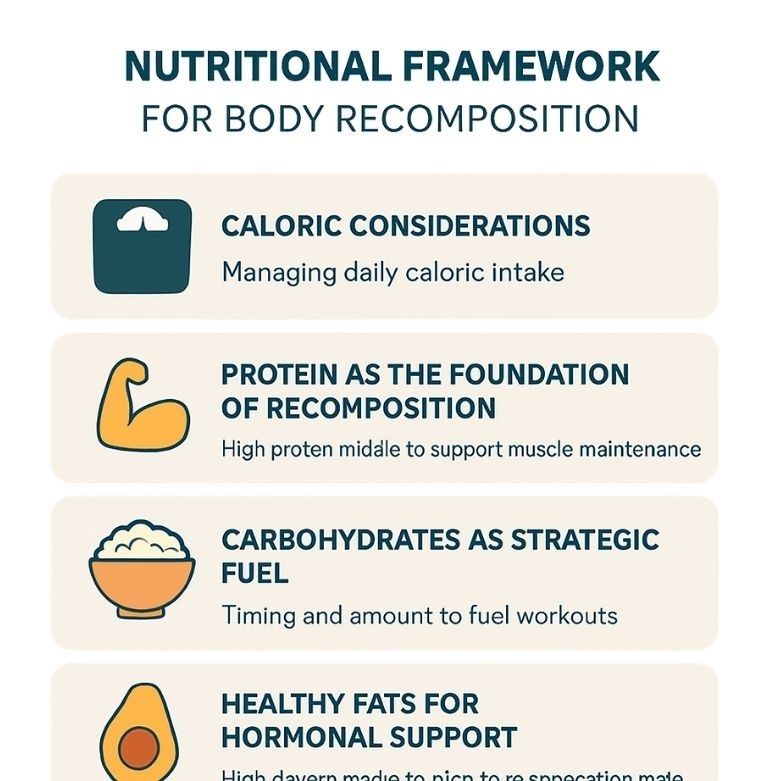
Caloric Considerations
Unlike traditional bulking or cutting phases, body recomposition involves a modest caloric deficit. Aim for a 10-20% deficit from your maintenance calories. For most individuals, this translates to approximately 300-500 calories below maintenance.
Calculate your approximate maintenance calories using this formula:
- Men: 10 * weight (kg) + 6.25 * height (cm) – 5 * age (years) + 5
- Women: 10 * weight (kg) + 6.25 * height (cm) – 5 * age (years) – 161
Then multiply by an activity factor (1.2 for sedentary, 1.375 for light activity, 1.55 for moderate activity, 1.725 for very active) to determine maintenance calories.
Protein: The Foundation of Recomposition
Protein intake is non-negotiable for successful body recomposition. Consume 1.6 to 2.2 grams of protein per kilogram of body weight daily. For a 70 kg individual, this means 112-154 g of protein daily. Distribute protein intake evenly across 4-5 meals (20-40 g per meal). Include a protein-rich meal within 2 hours of post-workout.
Quality protein sources to include are:
- Lean meats (chicken breast, turkey, lean beef)
- Fish and seafood (salmon, tuna, shrimp)
- Eggs and egg whites
- Dairy (Greek yoghurt, cottage cheese, whey protein)
- Plant-based options (tofu, tempeh, legumes, protein powders)
Carbohydrates: Strategic Fuel
Consume 2 to 4 g of carbs per kilogram of body weight daily. Higher intake on training days, lower on rest days. Prioritise carb intake before and after workouts.
Focus on complex, nutrient-dense carbohydrates:
- Whole grains like oats, brown rice, and quinoa
- Starchy veggies like sweet potatoes and squash
- Fruits like berries, apples, and citrus
- Legumes like beans and lentils
Healthy Fats: Hormonal Support
Dietary fats are important not only because they give your body energy and support cell function, but also because they have a crucial role in hormonal regulation.
Consume 0.5-1 gram of fat per kilogram of body weight daily. Ensure adequate intake of essential fatty acids. Focus on quality fat sources such as:
- Avocados
- Nuts and seeds
- Olive oil
- Fatty fish
- Egg yolks
Nutrient Timing for Favourable Results
The secret to improving body recomposition is to time your meals. Here’s a general guide:
Pre-workout nutrition (1-2 hours before)
- Moderate protein (20-30 g)
- Moderate to high carbohydrates (30-50 g)
- Low fat (5-10 g)
Post-workout nutrition (within 2 hours)
- High protein (30-40 g)
- Moderate to high carbohydrates (30-60 g)
- Low fat (5-10 g)
Remaining daily meals
- Balanced protein, carbs, and fats
- Focus on whole, nutrient-dense foods
- Adjust carbohydrate content based on your daily activity level
Dealing with Plateaus
When progress stalls, you might want to consider these adjustments:
- Calorie Cycling
- Alternate between maintenance and deficit calorie intake to prevent metabolic adaptation
- Vary your daily calorie intake
- Prevent your body from becoming too efficient at conserving energy
- Maintain metabolic flexibility
- Alternate between maintenance and deficit calorie intake to prevent metabolic adaptation
- Strategic Carbohydrate Management
- Implement high carb days strategically.
- Boost energy for intense workout
- Support muscle glycogen replenishment
- Help regulate metabolism-controlling hormones
- Implement high carb days strategically.
- Refeed Days
- Schedule planned higher-calorie days that are focused on carb intake.
- Provide a short break from calorie restriction
- Psychological relief from dieting
- Nutritional reset for your metabolism
- Refeed day guidelines:
- 50% from carbohydrates
- 30% from protein
- 20% from fat
- Usually used once every 1-2 week
- Helps restore leptin levels and support hormonal balance
- Schedule planned higher-calorie days that are focused on carb intake.
- Extended Diet Breaks
- Take periodic breaks from calorie restriction.
- Duration: 1-2 weeks
- Return to maintenance calorie intake
- Allow full metabolic and hormonal recovery
- Prevent long-term metabolic slowdown
- Maintain muscle mass and motivation
- Take periodic breaks from calorie restriction.
Conclusion
Remember that body recomposition is not merely about changing how you look—it’s about fundamentally improving how your body functions. Your journey toward improved body composition doesn’t have to be travelled alone.
For healthy weight loss and fat loss for men and women, contact us at Eureka Wellness.