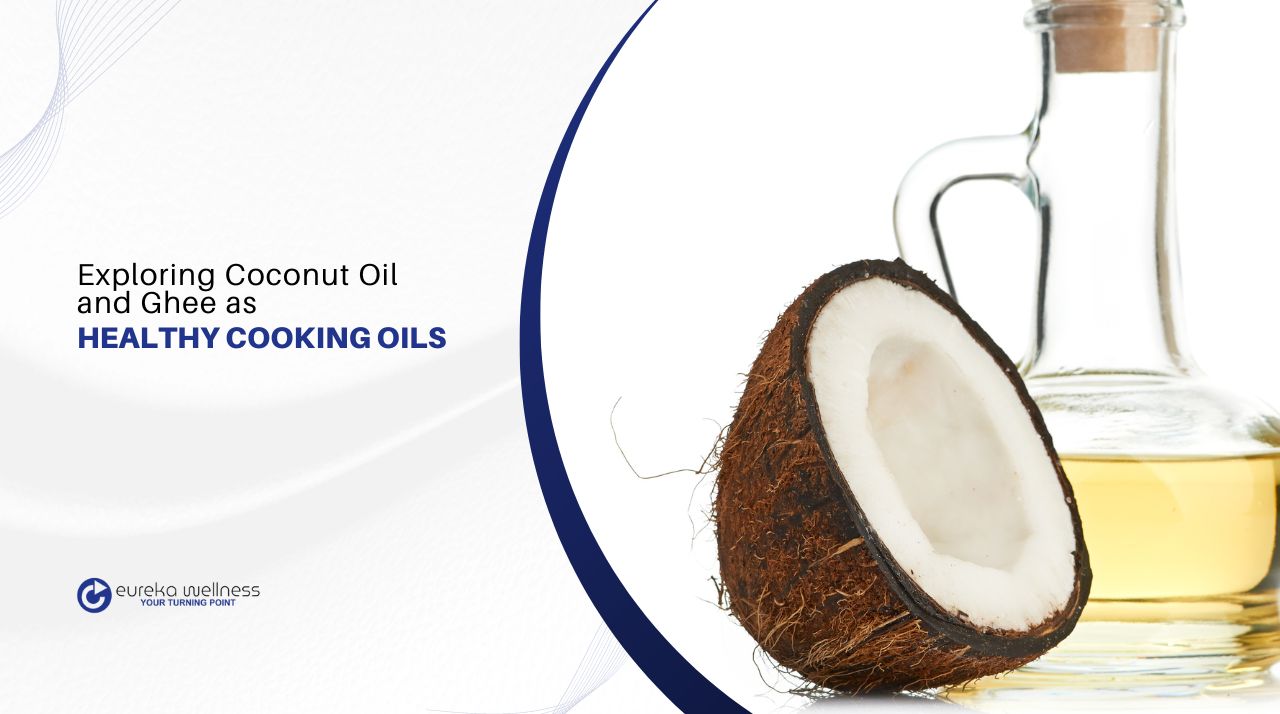


Cooking oils play a role in creating flavours, textures and aromas defining our favourite dishes. Among the numerous options available, coconut and ghee have gained attention, each with its own rich history and unique properties.
Let’s delve into their origins, production methods, and unique characteristics that set them apart in the wide array of cooking oils.
What are Cooking Oils?
Cooking oils are usually liquid fats derived from various sources, which are primarily used for frying, sautéing, and as ingredients in dressings and sauces. Looking closely at their components, they are composed of fatty acids.
Common sources of cooking oils are plants (extracted from their seeds, nuts or fruits), animals (like ghee), and synthetic compounds (such as hydrogenated oils).
The Role of Cooking Oils in Our Diet
Their role in your diet extends far beyond their culinary applications. Cooking oils provide essential fatty acids and other nutrients.
Sources of Healthy Fats
Cooking oils, especially those that are high in monounsaturated and polyunsaturated fats, help improve heart health by lowering bad cholesterol levels (LDL) and raising good cholesterol levels (HDL). One of the examples include olive oil.
Nutrient Absorption
Some vitamins like vitamins A, D, E, and K are fat-soluble, meaning they need fat to be absorbed by the body. Cooking oils help in the absorption of these essential vitamins.
Flavour and Cooking Efficiency
Oils enhance the flavour of food and allow for higher cooking temperatures as compared to water (cooking is faster and more efficient). They also help distribute heat evenly, so the risk of burning food is reduced with cooking oils.
Energy Source
Oils and fats are calorie-dense. They provide a concentrated source of energy. Just be sure to keep an eye on your portion sizes, as they are beneficial in moderation.
Versatility in Cooking
Different oils have different smoke points. For example, olive oil is great for sautéing and salad dressings while avocado oil is excellent for high-heat cooking like frying.
Coconut Oil, A Tropical Wander
Coconut oil is derived from the kernel or meat of mature coconuts harvested from the coconut palm (Cocos nucifera). It has been used for centuries in tropical regions, particularly in Southeast Asia, the Pacific Islands, and parts of South America and Africa.
Production Methods
There are two main types of coconut oil, virgin and refined.
- Virgin Coconut Oil (VCO)
- Wet Method: Fresh coconut meat is pressed to extract milk, which is then separated into oil and water through fermentation, centrifugation, or enzymatic processes.
- Dry Method: Dried coconut meat (copra) is pressed to extract oil. This method often involves minimal processing to retain the oil’s natural properties.
- Refined Coconut Oil
- Made from dried coconut meat that is mechanically pressed and then refined, bleached, and deodorised (RBD) to remove impurities and odour. This is done so that it would result in a more neutral flavour and higher smoke point.
Bleaching is a filtering process aimed at removing impurities, It is not a chemical process. A “bleaching clay” is employed for this filtration. Since copra is the initial material, steam is used to remove odours from the oil. As a result, the final product has a very mild flavour, with little to no odour.
The “bleaching” is generally not a chemical process, but rather a filter process to remove impurities. A “bleaching clay” is used for this filtering. Steam is used to deodorize the oil since the starting point was copra. So the resulting product has a very bland taste, with little or no odor.
Nutritional Composition
Coconut oil is primarily composed of saturated fats (90%) and 9% unsaturated fats, with a significant portion (50%) being medium-chain fatty acids, such as lauric acid.
Here is a breakdown of its typical composition per tablespoon (14 grams).
- Calories – 121
- Total Fat – 14 g
- Saturated Fat – 11.2 g
- Monounsaturated Fat – 0.8 g
- Polyunsaturated Fat – 0.2 g
- Vitamins and Minerals – Trace amounts of vitamins E and K.
Potential Health Benefits
- MCTs (medium-chain fatty acids) in coconut oil are quickly metabolised for energy, making it a quick source of fuel.
- Lauric acid has antimicrobial effects, which can help fight off pathogens.
- Some studies suggest MCTs may improve weight loss because these fats can more easily break down into molecules (ketone bodies).
- It also has potential benefits in reducing symptoms of Alzheimer’s disease due to ketone production from MCTs.
Smoke Point
Virgin coconut oil has a smoke point of approximately 350°F (176°C) which is suitable for medium-heat cooking like baking and sautéing.
Refined coconut oil’s smoke point, on the other hand, is approximately 400°F (204°C). This is good for cooking methods which require higher heat (such as frying).
Health Considerations
Coconut oil does offer many benefits, but it’s important to note that it is high in saturated fats, which can raise LDL (bad) cholesterol levels. It should be consumed in moderation, especially by those with heart health concerns.
Ghee, A Clarified Butter with a Rich History
Ghee is a clarified butter made by separating butterfat from the milk solids and water in butter. The milk caramelises and solidifies, while the remaining oil is ghee.
Production Process
It is made by simmering butter until the water evaporates and the milk solids separate. The milk solids are then removed, leaving behind pure butter fat. This process enhances the flavour and increases its shelf life.
Nutritional Profile
Ghee is rich in healthy fats, including conjugated linoleic acid (CLA) and butyrate (1%). It also contains fat-soluble vitamins such as A, E, and K.
Distinctive Characteristics
Ghee has a high smoke point of around 485°F (252°C). Hence, it is ideal for high-temperature cooking like frying and sautéing.
It has this rich, nutty flavour that can enhance the taste of various dishes. And the removal of milk solids makes it a suitable option for those who are lactose intolerant.
Potential Health Benefits
In digestive health, butyrate (though only about 1%, and isn’t much compared to what the colon naturally makes) is essential for keeping colon cells healthy and help them repair themselves.
CLA in ghee may help reduce body fat and improve heart health. Also, the fat-soluble vitamins in ghee aid in the absorption of other nutrients.
Is Ghee a Healthy Cooking Oil?
For those who are mindful of their health, ghee can be a good option due to its high smoke point and rich nutrient profile. However, you should use it in moderation, as it is high in saturated fats.
Balance ghee with other healthy fats like olive oil or avocado oil for a well-rounded diet.
Comparing Coconut Oil and Ghee
Coconut oil is best for those who prefer a coconut flavour and are looking for a vegan option with quick energy from medium-chain fatty acids.
There is also the option of the refined coconut oil, that does not impart the coconut flavour to food.
Ghee is ideal for high-heat cooking and those who enjoy a buttery flavour. It’s also rich in fat-soluble vitamins and beneficial for gut health.
Cooking Tips and Best Practices
For coconut oil,
- Use it for frying, sautéing, and baking.
- Use it when you want a subtle coconut flavour to dishes. Or, you can simply choose the refined coconut oil which carries a neutral flavour.
- Use it as a substitute for butter or other oils in baking if you want a moist texture and unique flavour.
- Store it in a cool, dark place. It may liquefy in warm conditions.
- Unrefined coconut oil can last two to five years while refined one has a shelf life of about 18 to 36 months.
For ghee,
- Use it for frying, roasting, and sautéing.
- Use it when you want a nutty flavour to dishes (similar to butter but more intense).
- Use it in place of butter for a richer taste in recipes.
- It is shelf-stable and can be stored at room temperature. Just be sure to keep it in an airtight container to prevent oxidation.
- Ghee can last up to a year when stored properly. You can extend its shelf life even further by refrigerating it.
Maximising Benefits
- Both coconut oil and ghee are rich in healthy fats. Use them in moderation to improve the nutritional profile of your meals.
- Consider making ghee at home to save money and ensure purity. Simply simmer unsalted butter until the milk solids separate and brown, then strain.
Feel free to experiment with these oils to find what works best for your taste and cooking style.
Understanding Labels and Quality
| Coconut Oil | 1) Look for “virgin” or “extra virgin” coconut oil, if you prefer the coconut flavour.
2) Choose cold-pressed or expeller-pressed oils. 3) Check for organic certifications like NASAA. 4) Opt for coconut oil in glass jars rather than plastic. 5) Look for oils sourced from reputable regions known for high-quality coconuts. |
| Ghee | 1) Look for “grass-fed” ghee.
2) Choose traditionally made ghee (often labelled “handcrafted” or “artisanal”). 3) Organic certifications are also important. 4) The label should list only one ingredient: butter or clarified butter. 5) Ghee in a glass jar is more preferable. |
Conclusion
These two healthy cooking oils are a great addition to your kitchen even if they have different nutritional profiles and health benefits. They can be part of a healthy diet when used moderately.
If you’re choosing between them, it all depends on your dietary needs, cooking methods, and flavour preferences.
Planning to maintain a healthy weight but don’t have full control over what you eat? Partner with a weight loss coach and talk to one today! Let Eureka Wellness help you achieve these health goals.